Asian
Indian Names
India is a country with numerous distinct cultural and linguistic groups. Thus, Indian surnames, where formalized, fall into seven general types. And many people from the southern states of Tamil Nadu and Kerala do not use any formal surnames, though most might have one. In spite of hiding their cast discrimination, Tamil people do not use their family or cast names. They use initials in front of their names (example J. John Vimalraj) instead. Again the initial J is stands for his father name John Peter, though they have their last name such as Muthaliyar, Kounder and etc…
In Northern India, most of the people have their family name after the given names, whereas in Southern India, the given names come after the family name.
* Patronymics and ancestry, where the father’s name or an ancestor’s given name is used in its original form or in a derived form (e.g. Aggarwal or Agrawal or Agrawala derived from the ancestor Agrasen).
* Occupations (Chamar, Patel or Patil meaning Village Headman, Gandhi, Kamath, Kulkarni who used to maintain the accounts and records and used to collect taxes, Kapadia, Nadkarni, Patwardhan, Patwari, Shenoy, etc.) and priestly distinctions (Bhat, Bhattar, Trivedi, Shukla, Chaturvedi, Twivedi, Purohit, Mukhopadhyay) Businesspeople: Shetty, Rai, Hegde is commonly used in kshatriyas casts of karnataka costal belt. In addition many Parsi, Bohra and Gujarati families have used English trade names as last names since the 18th and 19th centuries (Contractor, Engineer, Builder).
* Caste or clan names (Pillai, Gounder, Goud, Gowda, Boyar, Parmar, Sindhi, Vaish, Reddy, Meena and Naidu) are not surnames but suffixes to first names to indicate their clan or caste.
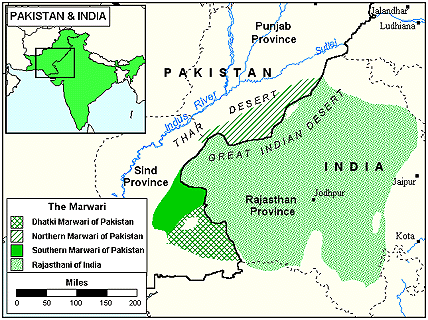
* Place names or names derived from places of ancestral origin (Aluru, Marwari, Gawaskar, Gaonkar, Mangeshkar, Kapoor, Wamankar, Kokradi, Karnad, Medukonduru, Rachapalli).
* A few last names originate from the names (Juthani)
* The father’s first name is used as a surname in certain Southern states, such as Kerala, Karnataka and Tamil Nadu. However after the marriage the bride uses her husband’s first name instead.
* Muslim surnames generally follow the same rules used in Pakistan. Khan is among the most popular surnames, often signifying Afghan/Central Asian descent.
* Bestowed titles or other honorifics (titles bestowed by kings, rajas, nawabs and other nobles before the British Raj (Wali, Rai, Rao, Tharakan, Panicker, Vallikappen, Moocken, etc.) and those bestowed by the British (Rai, Bahadur).
* Names indicating nobility or feudal associations or honorifics (Chowdary, Naidu, Varma, Singh, Burman, Raja, Reddy, Tagore, Thakur)
* Colonial Surnames based on tax or after religious conversion, particularly in Goa which was under Portuguese control (D’Cruz, Pinto). Often, surnames of Portuguese noble families who were accepted as godparents were used as the surnames of the converted. Some families still keep their ancestral Hindu surnames along with their given Catholic Surnames e.g. Miranda-Prabhu and Pereira-Shenoy.
* In Kerala the practice of using the house name before or after the given name is on the rise. For example Asin Thottumkal – Asin is the given name while Thottumkal is the house name.
The convention is to write the first name followed by middle names and surname. It is common to use the father’s first name as the middle name or last name even though it is not universal. In some Indian states like Maharashtra, official documents list the family name first, followed by a comma and the given names.
It is customary for wives to take the surname of their husband after marriage. In modern times, in urban areas at least, this practice is not universal. In some rural areas, particularly in North India, wives may also take a new first name after their nuptials. Children inherit their surnames from their father.
In some parts of Southern India, no formal surname is used, because the family has decided to forgo its existing clan name. There has been a minor reversal of this trend in the recent times. This practice is prevalent in Tamil Nadu and Kerala. For example, people from the kongu vellala gounder community of Tamil Nadu have in general two titles: the caste title Gounder and the clan name, example Perungudi. Nowadays it is common for people not to use any of these titles. So a Konguvel, son of Shanmuganathan, of say Erode, would call himself Konguvel Shanmughanathan, instead of the traditional Erode Perungudi Konguvel Gounder. This practise is of very recent origin though. Wife or child takes the given name of the husband or father (Usha married Satish, and may therefore be called Usha Satish or simply S. Usha). However in some families(Nair/Nayar), the children carry the last name of their mother instead of the father and are considered part of the mother’s family. In many communities, especially Syrian Christians of Kerala, names are formed by the family name or house name as the first name, the given name as the second name and the father’s/husband’s given name as the last name. For example, Palakkappillil John Thomas where Palakkappillil, John and Thomas are the family name, the given name and the father’s name respectively. Thus, the last name changes with each generation. The house name would change as generations move out of their consanguineal family homes with the changing ownership of property upon the death of the patriarch. The Dravidian movement in the beginning of 20th century was instrumental in knocking off the concept of surnames in Tamil Nadu. Since many companies in the industrially rich Tamil Nadu managed to filter candidates just by looking at their names, the movement went on to such an extent that surnames/castenames were simply refused at primary school levels. The movement went so active that even Streets, roads and galis where names with caste name was published, road-tar was applied on caste names. For instance in a Ranganatha Mudaliar street, the Mudaliar name was struck off with tar, leaving the street as Ranganathan Street. Similar was the case with almost all castes, Now it’s hard to find a Mudaliar, Nadar, Pillai, Goundar, Iyer, Chettiar etc. in any public display. Only on arranged marriages, people feel proud to publish their caste names. In cases where people arrange their own marriages (intercaste / inter religion), the caste name almost vanishes. Hence the famous “ETHIRAJA MUDALIAR College” in Chennai is simply “ETHIRAJ COLLEGE” or “Kamaraja nadar road” is simply “Kamaraj road”. This is being welcomed by politicians from UP, Bihar etc.
Jains generally use Jain, Shah, Firodia, Singhal or Gupta as their last names. Sikhs generally use the words Singh (“lion”) and Kaur (“princess”) as surnames added to the otherwise unisex first names of men and women, respectively. It is also common to use a different surname after Singh in which case Singh or Kaur are used as middle names (Montek Singh Ahluwalia, Surinder Kaur Badal). The tenth Guru of Sikhism ordered (Hukamnama) that any man who considered himself a Sikh must use Singh in his name and any woman who considered herself a Sikh must use Kaur in her name. Other middle names or honorifics that are sometimes used as surnames include Kumar, Dev, Lal, and Chand.
The modern day spellings of names originated when families translated their surnames to English, with no standardization across the country. Variations are regional, based on how the name was translated from the local language to English in the 18th, 19th or 20th centuries during British rule. Therefore, it is understood in the local traditions that Agrawal and Aggarwal represent the same name derived from Uttar Pradesh and Punjab respectively. Similarly, Tagore derives from Bengal while Thakur is from Hindi-speaking areas. The officially-recorded spellings tended to become the standard for that family. In the modern times, some states have attempted at standardization, particularly where the surnames were corrupted because of the early British insistence of shortening them for convenience. Thus Bandopadhyay became Banerji, Mukhopadhay became Mukherji, Chattopadhyay became Chatterji etc. This coupled with various other spelling variations created several surnames based on the original surnames. The West Bengal Government now insists on re-converting all the variations to their original form when the child is enrolled in school.
Some parts of Sri Lanka, Thailand, Nepal, Burma, and Indonesia have similar patronymic customs as that of India.
Turkey names
In Turkey, following the Surname Law imposed in 1934 in context of Atatürk’s Reforms, every family living in Turkey were given a family name. The surname was generally selected by the elderly people of the family and could be any Turkish word (or a permitted word for families belonging to official minority groups).
The most common family names in Turkey are ‘Yılmaz’ (means “undaunted”), ‘Doğan’ (falcon), ‘Şahin’ (hawk), ‘Yıldırım’ (thunderbolt), ‘Şimşek’ (Lightning), Öztürk (means “genuinely Turkish”). Some surnames include patronymic suffixes like ‘oğlu’ (meaning “son of”). However, these do not necessarily refer to ancestry or in most cases can not be traced back historically. ‘ov/ova’, ‘yev/yeva’ and ‘zade’ can be found as a suffix in the surnames of Azeri or other Turkic descendants.
Official minorities like Armenians, Greeks, and Jews have surnames in their own mother languages. The Armenian families living in Turkey usually have Armenian surnames and generally have the patronymic ‘yan’ (‘ian’). Likewise, Greek descendants also usually have Greek surnames which might have Greek patronyms like ‘oglou’ (From the Turkish suffix for “son of”, used for both genders), ‘ou’, ‘akis/aki’, ‘poulos/poulou’, ‘idis/idou’, ‘iadis/iadou’ or prefixes like ‘papa’. The Sephardic Jews who were expelled from Spain and settled in Turkey in 1492 have apart from Jewish/Hebrew surnames, also surnames in Spanish, usually indicating their native regions, cities or villages back in Spain like ‘de leon’ or ‘toledano’.
Chinese Names
Chinese family names have many types of origins, dating back as early as pre-Qin era (i.e., before 221 BCE):
* from the land or state that one lived in or awarded: Chen 陳 after the state of Chen, Cai 蔡 after the state of Cai;
* from the given name or Posthumous name of one’s ancestor: Zhuang 莊 after King Zhuang of Chu;
* from the nobility status or officer status of one’s ancestor: Wang 王 (a king) or Shi 史 (a history-recording officer);
* and some other origins.
In history, some changed their surnames due to a naming taboo (from Zhuang 莊 to Yan 嚴 during the era of Liu Zhuang 劉莊) or as an award by the Emperor(Li was often to senior officers during Tang Dynasty).
In modern days, some Chinese adopt a Western given name in addition to their original given names, e.g. Lee Chu-ming (李柱銘) adopted the Western name Martin, which can often be used as a nickname of Chu-ming. The adopted Western name can be put in front of their Chinese name, e.g. Martin LEE Chu-ming. In addition, many people with Chinese names have non-Chinese first names which are commonly used. Sometimes, the Chinese name becomes used as a “middle name”, e.g. Martin Chu-ming Lee, or even used a “last name”, e.g. Lee Chu-ming Martin. Chinese names used in Western countries may be rearranged when written to avoid misunderstanding, e.g. cellist Yo-Yo Ma. However, some well-known Chinese names remain in the traditional order even in English literature, e.g. Chiang Kai-shek, Mao Zedong, Yao Ming (Note that the name on the back of Yao Ming’s NBA jersey is “Yao,” rather than “Ming,” as the former is his family name). Most people from mainland China stick with their own national standard to present their names. For example, in all Olympic events all the PRC athletes’ names are presented in the Chinese ordering even when they are spelled out phonetically in Latin alphabets. Chinese athletes from other countries, especially those on the US team, use the Western ordering. The non-compliance to the Western ordering is a matter of cultural convention and also a national standard adopted by PRC.
Vietnamese names
Vietnamese names are generally stated in East Asian order (family name first) even when writing in English.
In English writings originating from non-English cultures (e.g. English newspapers in China), the family name is often written with all capital letters to avoid being mistaken as a middle name, e.g. Laurence Yee-ming KWONG or using small capitals, as Laurence KWONG Yee-ming or with a comma, as AKUTAGAWA, Ryūnosuke to make clear which name is the family name. Such practice is particularly common in mass-media reporting international events like the Olympic Games. The CIA World Factbook stated that “The Factbook capitalizes the surname or family name of individuals for the convenience of [their] users who are faced with a world of different cultures and naming conventions”. For example, Leslie Cheung Kwok Wing who is actually Mr.Cheung might be mistaken as Mr. Wing by readers unaware of Chinese naming conventions.
Vietnamese family names present an added complication. Like Chinese family names, they are placed at the beginning of a name, but unlike Chinese names, they are not usually the primary form of address. Rather, people will be referred to by their given name, usually accompanied by an honorific. For example, Phan Van Khai is properly addressed as Mr. Khai, even though Phan is his family name. This pattern contrasts with that of most other East Asian naming conventions.
Japan names
In Japan, the civil law forces a common surname for every married couple, unless in a case of international marriage. In most cases, women surrender their surnames upon marriage, and use the surnames of their husbands. However, a convention that a man uses his wife’s family name if the wife is an only child is sometimes observed. A similar tradition called ru zhui (入贅) is common among Chinese when the bride’s family is wealthy and has no son but wants the heir to pass on their assets under the same family name. The Chinese character zhui (贅) carries a money radical (貝), which implies that this tradition was originally based on financial reasons. All their offspring carry the mother’s family name. If the groom is the first born with an obligation to carry his own ancestor’s name, a compromise may be reached in that the first male child carries the mother’s family name while subsequent offspring carry the father’s family name. The tradition is still in use in many Chinese communities outside of mainland China, but largely disused in China because of social changes from communism. Due to the economic reform in the past decade, accumulation and inheritance of personal wealth made a come back to the Chinese society. It is unknown if this financially motivated tradition would also come back to mainland China.
HK and Macau Names
In Hong Kong, some women would be known to the public with the surnames of their husbands preceding their own surnames, such as Anson Chan Fang On Sang. Anson is an English given name, On Sang is the given name in Chinese, Chan is the surname of Anson’s husband, and Fang is her own surname. A name change on legal documents is not necessary. In Hong Kong’s English publications, her family names would have been presented in small cap letters to resolve ambiguity, e.g. Anson CHAN FANG On Sang in full or simply Anson Chan in short form.
In Macau, some people have their names in Portuguese spelt with some Portuguese style, such as Carlos do Rosario Tchiang.[19]
Chinese women in Canada, especially Hongkongers in Toronto, would preserve their maiden names before the surnames of their husbands when written in English, for instance Rosa Chan Leung, where Chan is the maiden name, and Leung is the surname of the husband.
In Chinese, Korean, and Vietnamese, surnames are predominantly monosyllabic (written with one character), though a small number of common disyllabic (or written with two characters) surnames exists (e.g. the Chinese name Ouyang, the Korean name Jegal and the Vietnamese name Phan-Tran).
Many Chinese, Korean, and Vietnamese surnames are of the same origin, but simply pronounced differently and even transliterated differently overseas in Western nations. For example, the common Chinese surnames Chen, Chan, Chin, Cheng and Tan, the Korean surname Jin, as well as the Vietnamese surname Trần are often all the same exact character 陳. The common Korean surname Kim is also the common Chinese surname Jin, and written 金. The common Mandarin surnames Lin or Lim (林) is also one and the same as the common Cantonese or Vietnamese surname Lam and Korean family name Lim (written/pronounced as Im in South Korea). Interestingly, there are people with the surname of Hayashi (林) in Japan too. The common Chinese surname 李, translated to English as Lee, is, in Chinese, the same character but transliterated as Li according to pinyin convention. Lee is also a common surname of Koreans, and the character is identical.